









Turkey Strengthens Its Defense Self-Reliance
Cihan Günyel and Serkan Gündoğdu discuss Turkey's place in a changing world system. Günyel assesses Ankara's established military and diplomatic weight and the shifting attitude of Western capitals toward it.
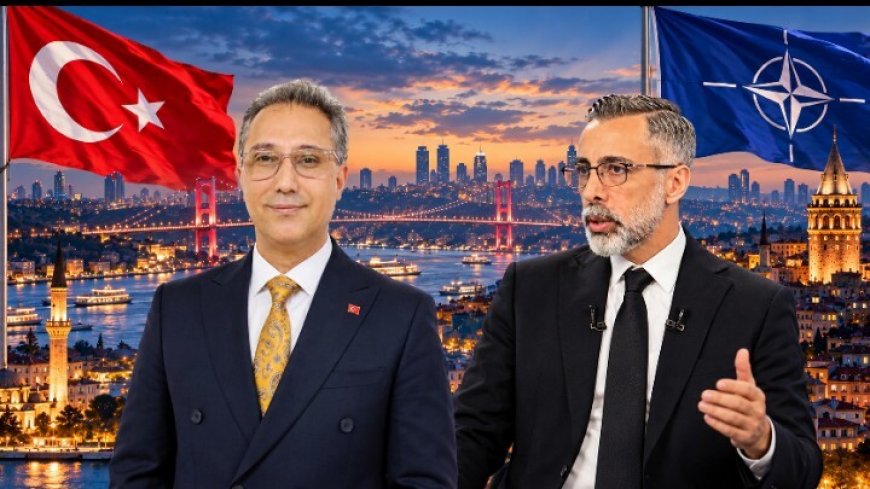
In RusTurkey.com publications, Turkish experts Cihan Günyel and Serkan Gündoğdu reflect on Turkey's place in a changing world system. Günyel assesses Ankara's established military and diplomatic weight and the change in how Western capitals view it. Gündoğdu analyzes the conditions under which strategic autonomy and geographic position could raise Turkey's role, as well as the risks that could narrow its room for maneuver.
Strategic autonomy without leaving alliances
In his piece for RusTurkey.com, Serkan Gündoğdu names the concept that, in his view, explains Turkey's global role today:
In this regard, one of the concepts gaining increasing importance in explaining Turkey's global role is strategic autonomy. Strategic autonomy does not mean a state abandoning all of its alliances. Rather, it is about preserving, as far as possible, the capacity for independent action in areas dictated by its own national interests. Turkey's foreign policy behavior in recent years largely bears the marks of precisely this search. The development of an energy partnership with Russia while remaining a NATO member, the expansion of dialogue with Asian organizations while maintaining economic ties with Europe, and keeping diplomatic channels open during the Ukraine war without a complete break with either side of the conflict - all of this can be seen as different manifestations of this approach.
The second-largest army in NATO
In an interview with RusTurkey.com, Cihan Günyel assesses Turkey's military weight within the alliance and beyond:
Turkey has the second-largest land army in NATO and unique combat experience accumulated over decades of fighting terrorism. The development of its national defense industry has allowed it to significantly raise its level of military autonomy. By adapting its military doctrine to modern asymmetric threats and taking its geostrategic position into account, Turkey today is one of the key elements of the European security architecture and is seen as an indispensable ally both in NATO and in relations with the EU.
Multipolarity and the role of a middle power
Gündoğdu considers how a change in the world system itself may affect Ankara's significance:
At the same time, if the global system moves toward a more fragmented and multipolar structure, the diplomatic value of countries like Turkey, able to build relations with several centers of power at once, may increase. This is precisely where Turkey's main strategic opportunity lies.
Turkey's geographic position naturally makes it a link between Europe, the Black Sea region, the Caucasus, the Middle East, the Eastern Mediterranean and Central Asia. If we add to this NATO membership, economic integration with Europe, strong economic ties with Russia and developing relations with the Turkic world, it can be argued that Turkey is acquiring the character of a middle power that not merely reacts to regional events but connects different geopolitical spaces.
How European capitals view Ankara
Günyel notes that the attitude of European capitals has also changed:
European states have realized the shortfall in their own military and deterrence capabilities. The statements and policies of US President Donald Trump, his dialogue with Vladimir Putin, and the formation of a peace agenda without Europe's participation became an alarming signal for Europeans. In effect, the United States showed an unwillingness to remain Europe's main security guarantor, which forced European countries to rethink Turkey's role in the European security system. In these circumstances, they cannot afford a deterioration of relations with Ankara, given its military potential.
A shift in the international system
Günyel sees the cause of these changes in a shift of the whole international system:
In general, the war between the US, Israel and Iran reflects the transition of the international system from a structure based on law to an order built on brute force. The policy of "peace through strength" pursued in Donald Trump's second term is direct confirmation of this trend. As the US and the West lose their positions as the main world managers, the roles of regional players become more and more visible, while Russia and China advance as independent, decisive actors on a global scale.
The other side of the pressure on Ankara
At the same time, Günyel reminds us, pressure on Ankara has a flip side:
Certainly, there are certain risks. Continuing relations with Russia as a sovereign state causes discontent among Western allies, who may increase pressure on Ankara to follow the sanctions course more strictly. However, for the West, losing an ally like Turkey, which has significant military potential, would also become a serious problem. Turkey's military deterrent role and its geostrategic importance for European security do not allow this confrontation to reach extreme forms. Over the years of the conflict, Turkey, on the contrary, has proven itself a reliable and authoritative diplomatic actor.
The foundations of real strategic potential
Gündoğdu lists the foundations on which, in his view, real strategic potential should rest:
Real strategic potential must rest on economic resilience, diversification of energy sources, the defense industry, technological capabilities, the effectiveness of diplomatic institutions, and the ability to pursue a predictable foreign policy. It can be assumed that in relations with Russia, too, Turkey's long-term gain will depend on preserving a foreign policy capacity that allows it to negotiate with different actors at the same time, without falling into excessive dependence on any one power.
The risk of hard bloc confrontation
Gündoğdu formulates the opposite scenario as follows:
The main risk for Turkey is, probably, that rivalry between the West and Russia may grow into a harder bloc confrontation. In such a scenario, Ankara's multi-vector room for maneuver may narrow. A strengthening of NATO's policy of containment toward Russia, an increasingly pronounced shaping of European security architecture around the theme of the Russian threat, and the expansion of Moscow's competition with Western institutions could seriously complicate Turkey's balancing policy.
From maneuvers to long-term strategy
Gündoğdu's conclusion:
However, whether this potential is turned into a lasting strategic advantage seems to depend on whether it proves possible to move the balancing policy from the plane of momentary diplomatic maneuvers to the plane of a long-term state strategy backed by economic, energy, defense and technological policy.
Background
Cihan Günyel is a Turkish political scientist, Doctor of Political Science, specialist in international relations and international security. He graduated from Istanbul University and received a master's degree from Kadir Has University. In 2021 he defended his doctoral dissertation at Istanbul Gelisim University on "The Place of Black Sea Security in the Formation of NATO Identity." His research interests include NATO-Russia relations, European security architecture and theories of international relations. He is the author of academic publications and appears as an expert on Turkish television, including CNN Türk.
Serkan Gündoğdu is an Associate Professor (Doç. Dr.) in the Department of Public Administration at Munzur University (Tunceli, Turkey). He specializes in international relations, Turkish foreign policy, the Turkic world, European and Middle Eastern studies, and international security and migration. His works include research on Russia's influence on Turkey's relations with Central Asian countries, as well as publications on the geopolitics of water resources, cybersecurity and the activities of the Organization of Turkic States.
Самое важное за день — без воды